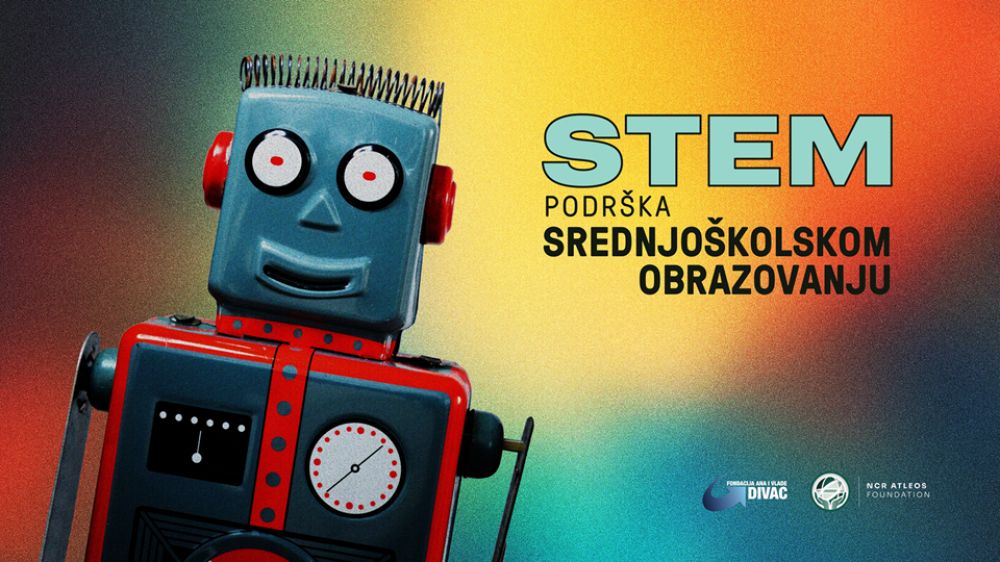
The Ana and Vlade Divac Foundation and the NCR Atleos Foundation have published a public call for secondary schools across the Republic of Serbia to apply for the procurement of modern equipment, with the aim of ensuring higher-quality education in STEM fields - science, technology, engineering, and mathematics.
The call is launched within the project “STEM Support to Secondary Education in Serbia,” which plans to support at least 15 schools, organize three science camps for secondary school students from different parts of Serbia, and provide training for secondary school teachers. The project aims to contribute to improving STEM knowledge and skills among more than 10,000 students across Serbia, as well as strengthening teachers’ capacities to apply modern teaching methods.
The development of STEM education plays a key role in preparing young people for future professions and enhancing the competitiveness of a knowledge-based society. At the same time, it fosters critical thinking, digital skills, and interest in innovation and science, while contributing more broadly to technological progress and long-term economic development.
Secondary schools may apply for equipment donations of up to RSD 450,000, which are necessary for delivering modern teaching and extracurricular activities, and which will help them effectively present STEM subjects to their students. The deadline for online applications is April 7, 2026, at 4:00 PM.
Schools that have previously received equipment through STEM education support projects implemented by the Ana and Vlade Divac Foundation are also eligible to apply; however, priority will be given to schools that have not yet received support.
Within this call, the Ana and Vlade Divac Foundation will also select and support an additional five secondary schools from suburban areas across Serbia, thanks to additional support from Myriad Canada.
For more details about this call and the application form please click HERE.
The Ana and Vlade Divac Foundation has been committed for many years to improving conditions for quality education for children and youth. To date, 298 educational institutions (primary and secondary schools) have been reconstructed and/or equipped with essential educational equipment. In addition, more than 1,000 talented students from disadvantaged families receive monthly scholarships, and 1,831 participants have completed a free IT retraining program.